Introducing the AI Operating Model for Industrial Operations
Over the past several weeks, we've had the opportunity to speak with operational leaders from many industries across all areas of their operations. While the organizations differ in size and sector, many of the conversations have converged on the same underlying challenge.
Industrial companies are not struggling because they lack data, they are struggling because operational complexity continually hinders their ability to absorb, interpret, prioritize, and act on that data.
Teams are expected to coordinate across more systems, more facilities, more stakeholders, and more information than ever before, often while experienced personnel retire and expectations for responsiveness continue to rise.
These discussions led us to step back and ask a simple question, if AI is going to create transformational value in industrial operations, what operational capabilities should it strengthen?
The result is The AI Operating Model for Industrial Operations.
Rather than viewing AI as a collection of isolated technologies, copilots, or autonomous agents, we believe organizations should think about it as an operational capability layer that helps them navigate complexity more effectively. The greatest opportunity lies not in generating more information, but in helping organizations make better decisions and execute with greater clarity and consistency.
The model is built around four connected capabilities:
- Awareness – understanding what is happening across the operation.
- Prioritization – determining what matters most.
- Coordination – aligning people, systems, and workflows to respond effectively.
- Organizational Intelligence – preserving knowledge and continuously improving how work gets done.
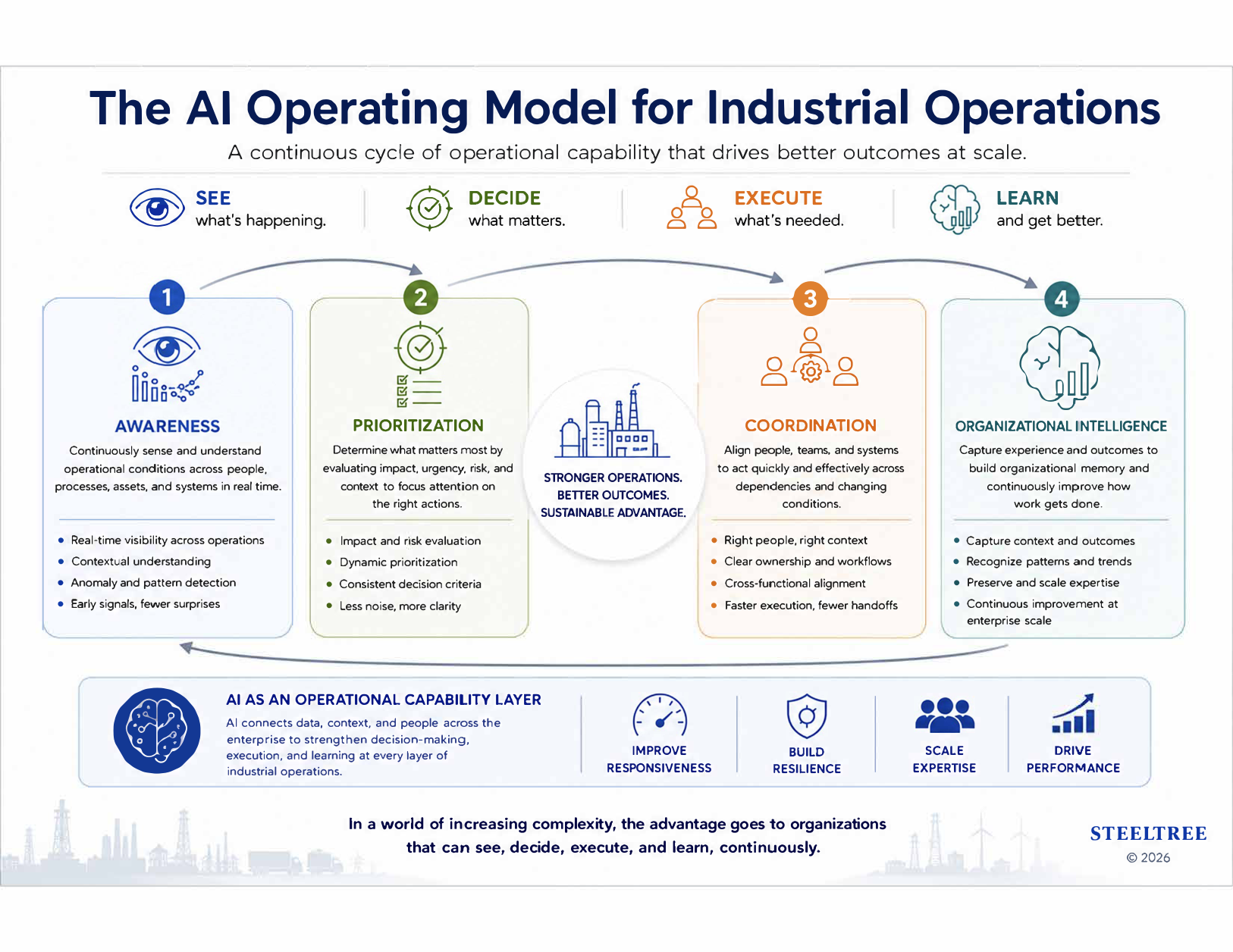
Together, these capabilities provide a practical framework for applying AI to real operational challenges and for evaluating AI initiatives based on business outcomes rather than technology alone.
The Executive Summary below outlines our thinking in more detail. We hope it contributes to the broader conversation and provides a useful perspective for industrial leaders exploring how AI can deliver measurable value.
Read the Executive Summary
Read the Executive Summary (PDF) — opens in your browser, where you can also download a copy.
Download the PDF directly